

08 June 2026
An oral guide to the new Brookwood 1914-1918 Memorial
The Commonwealth War Graves Commission is building a new memorial to the missing, the Brookwood 1914-1918 Memorial, in our largest UK site.
The Brookwood 1914-1918 Memorial is unlike anything we’ve ever built before. A completely new design philosophy has guided the creation of this space, driven by peace, contemplation, and how our sites interact with their surrounding landscapes.
Of course, the memorial still supports our primary purpose: the commemoration by name of 1.7 million men and women who died in military service during the world wars.
In this case, 400 newly-discovered First World War casualties with no known war grave who died as a result of military service in the UK will be commemorated on the new Brookwood 1914-1918 Memorial.
Learn more about the Brookwood 1914-1918 Memorial from those involved in the design process and our Commemorations Team to discover how this exciting new chapter in commemoration has unfolded.


At a Glance: what's on this Page
This page gives insights into the creation of the Brookwood 1914-1918 Memorial, including:
- How the names for inclusion on the memorial were chosen from CWGC Commemorations Policy Officer Fiona Kingston
- The design process and material choices from architect Bradley Moore
- The memorial's horticulture and sustainability from CWGC Director of Horticulture David Richardson and famed landscape garden designer Tom Stuart-Smith
- Ways to explore Brookwood beyond the new 1918-1918 Memorial
The Brookwood 1914-1918 Memorial: A Guide
Selecting the names
400 names will be carved into the memorial stelae. These are men and women who served in the First World War, but who died in the British Isles in military service and have no known war grave.
But how did we find these names? Fiona Kingston, CWGC Commemorations Policy Officer, explains.
“The work that Commemorations did followed a number of different strands,” Fiona says. “We started with the old memorial. We had casualties whose graves had been located, so we knew that those names were going to have to come off the old memorial.
“For every other name that was on the old memorial, the team reviewed those cases, around 250, to ensure that we couldn't find a grave location for these casualties.
“In some cases, we were successful, and we were able to find a grave location. In others, we could say, no, there's no grave for this casualty; they're going to need to go on to the new memorial.
“But all the while, we have an influx of new cases coming in. We are still receiving roughly 350 cases of non-commemoration every year. For every new case that was coming in, we were assessing whether we were going to be able to find their grave. And if so, will we be able to progress to a grave found?
“But if we aren't able to find a grave, then they were a candidate to go on the new memorial.
“So, we had all these different strands kind of coming together that allowed us to then say we've got roughly 400 names at this moment in time that we think need to be commemorated on the memorial.”
Designing the new Brookwood 1914-1918 Memorial
The Brookwood 1914-1918 Memorial design interweaves our ongoing commemorative work with the very landscape in which it sits. It also takes a new approach to commemorative panels, which have been sustainably sourced without losing sight of the memorial’s purpose.
30 monumental stone memorial stelae and a central dedication stele are dotted around a winding grass path under a woodland canopy. Some stelae will be left blank to account for new names discovered by the Commemorations Team.
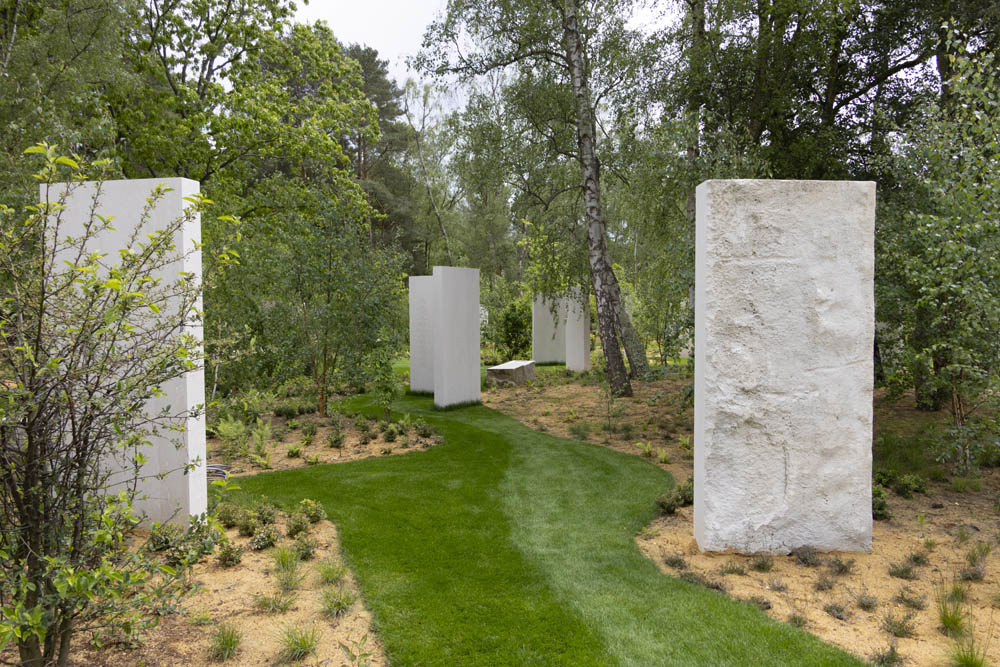
Together, horticulture and masonry combine into a memorial with space to grow, positioned in a living landscape, reflecting that commemoration is not static. It is an ongoing responsibility and one we take on behalf of the Commonwealth in the UK and worldwide.
We partnered with architects Studio Wignall & Moore to realise the Brookwood 1914-1918 Memorial. We spoke to the studio’s Bradley Moore, one of the architects who worked on this project, to learn more about the design rationale.
“Honouring the past, but also making something that's relevant today, is probably one of the toughest parts of our design process and the most interesting,” said Bradley.
“We began it with the core principle of the commission that everybody should be remembered the same way and forever. And making sure that that's done in a way that befits the sacrifice of all the men and women of the Commonwealth who made that sacrifice.
“Building from that, we began to look at a way to help more people engage with the process of remembering and engage with this memorial. So, our thoughts really moved to the idea of a place which people would come to in addition to the act of remembrance. They'd come here as a place to be calm, a place to relax, and a place to reflect.
“And the way we think we've achieved that is this idea of the memorial as a landscape, not just a grand memorial.”
Blending commemoration with architecture
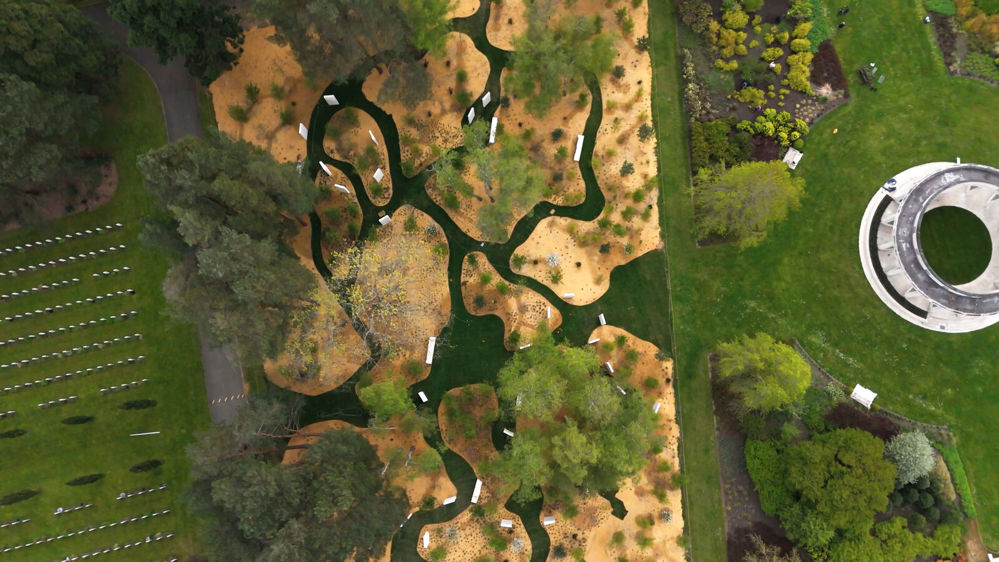
Image: A bird's-eye view of the Brookwood 1914-1918 Memorial. In time, the yellow sandy sections will feature healthy, resilient trees, shrubs and other plants
In designing the new memorial, we really wanted to emphasise the ongoing nature of our work in commemorating 1.7 million men and women of the Commonwealth, as Bradley explains.
“Really, we were guided by this idea of commemoration as a perpetual process. It's not something which happened in the past and now ends. The act of remembering is ongoing, but the act of commemorating is still ongoing.
“The Commission is very active, constantly doing more work, making sure that everybody is remembered equally. So, what we've done is place a series of stones, some of them full of names, some of them partly full, and actually some of them entirely blank, for the names to come.
“Now the nature of these stones, this idea of them being scattered through the landscape, obviously that needs to be treated in such a way that gives it a rigour and a rhythm.
“However, we've used a mechanism which still brings a real reason why the stones are laid out in the way they are. And that's looking at the star map, which is the stars in the sky above Northern Europe at 5 a.m. on the 11th of the 11th, 1918, the moment the Armistice was signed.
“And through pinpointing that star chart, using it in effect as an architectural drawing and overlaying it onto the site, where each star is placed on the site, is exactly where we've placed one of our stones.
“That for us really helps the memorial be bigger than itself. It reminds us all that those stars were and are shared by everybody, both in the past and in the future.”

Want more stories like this delivered directly to your inbox? Sign up for our newsletter for regular updates on the work of Commonwealth War Graves, blogs, event news, and more.
Sign UpSustainability in stone
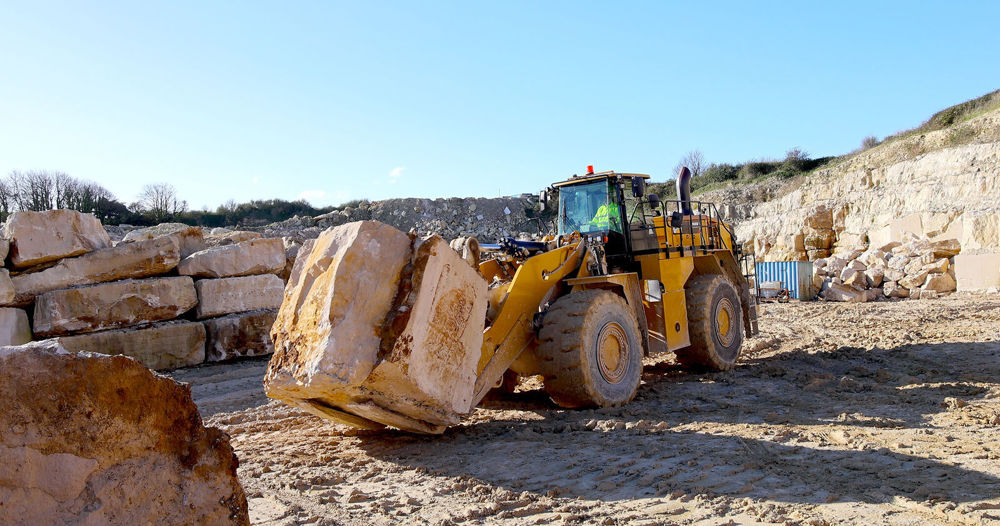
Image: Using rough stone to build the Brookwood stelae resulted in less waste
The future is key to the memorial. Its design is built around the idea of growth and ongoing commemoration, but that also means incorporating sustainability into its construction and care.
The Portland stone stelae embody this approach. Over to Bradley to explain more.
“Sustainability for the commission and for us is really one of the first drivers of this brief.
“We spent time on the Isle of Portland at the quarries, in fact, the same quarry, the same beds of stone from which some of the first stone that the commission used was taken and looked at their waste streams.
“The huge slabs of stone which come out of the ground are too rough and too kind of un-uniform to be used for a lot of the modern building work that Portland stone is used for. So, we selected that waste stone; that's the key component for our scheme.
“Ultimately, what we have here is 31 monolithic, single, huge pieces of stone and nothing else. And that stone, if we hadn't used it, a lot of that stone would have gone to waste.
“What we do as well is every face of every stone is perfect, as it should be. All people who are commemorated here are remembered in the same way. There's no distinction between them.
“However, the backs of the stone are left to nature. So, some of them are different shapes, some of them are ragged, some of them are smooth. And that all comes from the quarry.
“We're not spending energy on machining that to make it flat, and we're not wasting material to find stones that are perfect all around. And we just need a perfect face on the front.
“The other key element is the foundation design. We worked with Atelier One engineers from day one to ensure we have a concrete-free foundation system.
“So, all of these stones, as huge as they are, are safely held in the ground without pouring tons and tons of concrete into it.”
A woodland landscape in Brookwood
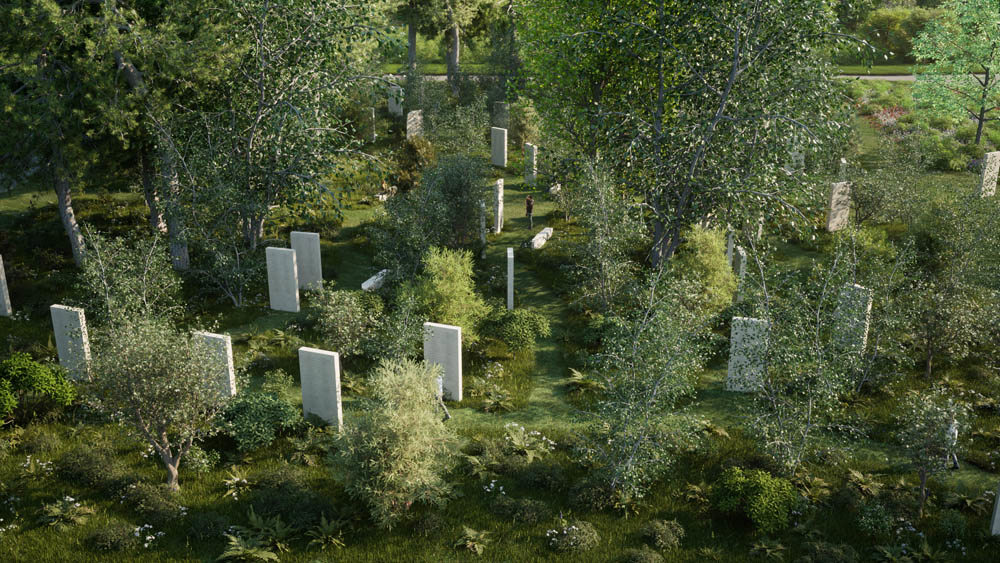
Image: This artist's rendering shows how the Brookwood Memorial will turn into a beautiful woodland landscape over time
Beautiful landscaping and horticulture are synonymous with CWGC sites, and Brookwood promises to be no different. In time, the Brookwood 1914-1918 Memorial will bloom into a stunning woodland landscape.
To understand better the rationale behind this woodland approach, we spoke to famed landscape gardener and designer Tom Stuart-Smith alongside CWGC Director of Horticulture, David Richardson.
“I'm very, very interested in how we memorialise things and how that has to change over time,” Tom said. “In a hundred years, what does a memorial look like when nobody has any relation, nobody living has any relationship to people who are on the memorials? One has to see some of these memorials as receding.
“What we're doing here seems to be a rather sort of delicate and very elegiac move towards that, that, you know, it's been situated in a birch wood that seems to be sort of encroaching on the memorial.”
When it comes to selecting species for the new Brookland woodland, the local environment dictated choices.
Not only does this ensure the woodland growth we’re looking for, but it also helps in terms of sustainability and plant care, as Tom Stuart-Smith explains: “All the plants we're using are plants that naturally occur around here. We're using things like purple moor grass, we're using heather, we're using native ferns, so that they will be part of that natural succession.
“We’re planting something with a sort of more rarefied version of what we would expect to find here anyway. So, we would hope that once it's established, the level of maintenance you'd be doing here would be very, very low.”
39,000 Trees for 2039 and beyond
“Trees are at the heart of this memorial in terms of planting,” David Ricahrds, CWGC Director of Horticulture, said. “And by 2039, we're going to establish 39,000 trees in our global estate, which is probably doubling what we have at the moment.”
Tom Stuart-Smith said: “The primary species here is silver birch because it's the primary kind of colonising tree of this site. And there's quite a lot of it, so we wanted to blend in with what we've got. Silver birch is a tree that's on the sort of risk register in terms of climate change.
“So it is there primarily as a sort of nurse for the longer-lived and more climate-resilient trees, which are things like the pin oak, the willow-leaved oak, the Scots pine, which I would envisage that in 100 years, they're going to be the principal trees on this site. And some of them are going in quite small, but they will, you know, be nursed by the birch.
“That is a change from the way maybe one would have designed a landscape sort of 50 years ago, when you envisaged those trees that you're putting in as being the trees that are going to be there in 50 years. That's not how we see this.”
“Our sites worldwide, they have that remarkable sense of place,” David added. “It's one of those intangibles, and I think this is going to be part of that sort of canon of wonderful places, both for people who are interested in battlefield and war history, but also as a beautiful landscape to come and enjoy and contemplate.”
Explore more: Brookwood & Beyond
Brookwood is just one part of our global work commemorating the Commonwealth’s fallen of the World Wars.
Here are some ways you can explore the Commonwealth War Graves Commission to learn more about who we are, what we do, and who we commemorate.
Find a name & search our recordsVisit usHow we care for war gravesGet involvedSupport the Commonwealth War Graves Foundation
Frequently Asked Questions
The memorial unveiled in 2015 honoured First World War casualties who died in the United Kingdom and Ireland and have no known grave. Since then, we have discovered more casualties for commemoration and furthermore, we have located the final resting places of some of those listed on the previous memorial, which is why a new memorial is now needed: to ensure every individual is remembered and commemorated.
400 service personnel will be commemorated on the new memorial. As research progresses, additional names will be added, with space available to record up to 1,200 names.
Many names were uncovered in the last decade by the In From The Cold Project, volunteers who combed military records, death certificates, and local archives.
In addition, the Commission has located the graves of approximately 250 servicemen and women who were previously commemorated on the memorial. These casualties will now be honoured at their original burial locations. This vital work – locating casualty graves and ensuring appropriate commemoration - restores their place of remembrance within the communities where they were originally laid to rest. Over 100 years later, our work continues.
Sustainability has been woven through every stage at this project.
Names will be engraved on sustainably sourced Portland stone, that uses all parts of the quarried stone, with normally wasted off cuts being used as seating. The stone from the previous memorial will be sent to local craft colleges.
The surrounding landscape uses wildflowers and pollinator friendly planting to support biodiversity and create a tranquil, living habitat. We will plant over 600 trees in the scheme.
No, only the area we are working in will be closed during construction, the majority of the site and all graves will remain open for visitors throughout the works.
This memorial has been designed by Studio Wignall & Moore, working closely with internationally acclaimed landscape Architect Tom Stuart-Smith.
The design honours the fallen while enhancing the natural environment. The memorial’s stone tablets are arranged to mirror the pattern of stars as they appeared on 11 November 1918: the night the Armistice came into effect on the Western Front. Set within carefully landscaped grounds, the design strikes a balance between solemn remembrance and a biodiverse, peaceful environment for reflection.
A stele (STEE-lee) is a stone slab, generally taller than it is wide, erected in the ancient world as a monument. The surface of the stele often has text, ornamentation, or both. These may be inscribed, carved in relief, or painted. Here at Brookwood we are using large stone Stele with the names of the missing engraved into the surface.
This new memorial marks the beginning of an important new chapter for Brookwood. We’ll be sharing regular updates on the construction process across our social media channels and here on our website, giving you a behind-the-scenes look at how a memorial of this significance is brought to life by our team of experts. Make sure you are signed up to our newsletter here.
Brookwood is more than a place of remembrance; it’s a living, breathing community dedicated to honouring history.
Here’s how you can be part of it:
Join our events
From moving commemorative services to uplifting concerts, Brookwood Military Cemetery hosts a vibrant calendar of events that bring people together in remembrance and celebration.
Volunteer with us
Lend your time, skills, and passion. Whether you have green fingers for gardening or a voice for storytelling, there’s a place for you in our volunteer family.
Support The Commonwealth War Graves Foundation
Join our charitable foundation or make a donation to help us inspire the next generation. Your support fuels our education and outreach work, ensuring the stories of those we commemorate are never forgotten.
Author acknowledgements
Alec Malloy is a CWGC Digital Content Executive. He has worked at the Commonwealth War Graves Commission since February 2022. During that time, he has written extensively about the World Wars, including major battles, casualty stories, and the Commission's work commemorating 1.7 million war dead worldwide.