02 June 2026
Volunteers Week 2026: Sharing Stories from Commonwealth War Graves's Volunteer Community
This week, 1-7th June, marks Volunteers’ Week, the international celebration of the work that volunteers carry out for organisations all over the world.
At Commonwealth War Graves, we are privileged to have almost 3000 volunteers globally who carry out a range of roles to support the organisation, ranging from operational roles to engaging with the public and carrying out research.
This Volunteers' Week, we are delighted to share a selection of stories about the CWGC volunteering community.
Volunteers Week 2026
A remarkable contribution recognised
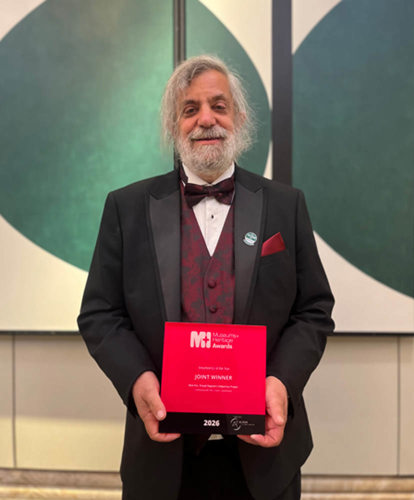 Image: Nick Ezra celebrates with his award
We are delighted that one of our UK volunteers, Nick Ezra, has been named as the joint winner of the prestigious Museum and Heritage Volunteer of the Year Award for his work on the Punjab Registers Project.
Nick began volunteering with us in 2021 as an Eyes On, Hands On (EOHO) volunteer, caring for nine sites across Norfolk, with a total of 23 war graves.
In 2022, he became involved with supporting our Non-Commemoration Team, where he has been involved with multiple projects. First, Nick checked and transcribed casualty information from 915 archival records for the King’s African Rifles.
This work requires a keen eye for detail and a great deal of patience and skill, especially when transcribing original handwritten documents. Nick’s work is clear and concise, and greatly sped up our ability to commemorate these individuals through his quick and thorough examinations of the data.
Nick has also been central to our analysis of the Punjab Registers. These registers contain the names of over 300,000 men from the Punjab who served in the First World War. Working in collaboration with the UK Punjab Heritage Association and the University of Greenwich, these files have been digitised and the data extracted and transcribed into Excel spreadsheets.
As we were aware of a gap in our records, it was decided to undertake a volunteer-led exercise to compare the 15,925 individuals listed as dead in the Punjab Registers against the 74,000 Indian names held in our casualty database. By the end of October 2025, Nick had actively checked all 15,925 names - a remarkable achievement!
Speaking after receiving the award, Nick told us: "I am proud on behalf of the whole volunteer community, and I am proud of the CWGC. It really is an important thing that we are doing, both colleagues and volunteers, because I was not alone. It is a different part of the United Kingdom’s heritage, and it is very important to do it."
Marking 10 years of service
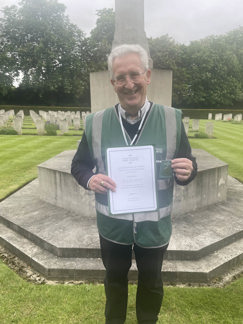 Image: Dick and his service certificate. Thank you Dick!
Celebrating Volunteers Week this year is particularly significant, as it marks ten years since the organisation first began bringing on volunteers to support with projects.
During War Graves Week, we were delighted to award CWGC Volunteer Dick Richards with his 10-year long service badge and certificate. Dick first started volunteering in 2016 to support the Somme Centenary Project Living Memory.
Following on from this project, he became involved in giving talks and tours of Oxford Botley Cemetery, and as volunteering became formalised in 2020, he joined the Speakers Programme and has since delivered 33 talks to almost 1200 attendees.
Congratulations to Dick for completing his ten years of service!
Learning in the Landscape: Eyes On, Hands On Volunteers Explore the Ypres Salient
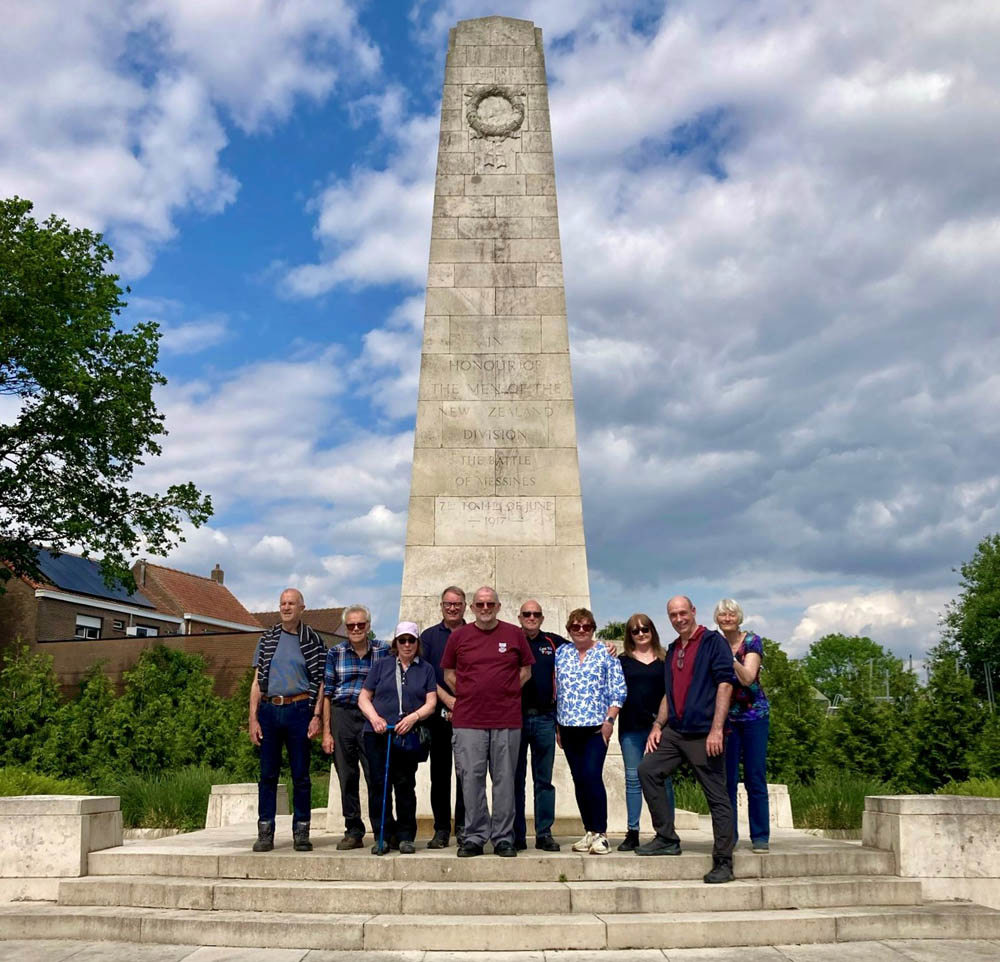
Image: Eyes On, Hands on Volunteers on tour
A CWGC Educational Story from the London & Southeast Region
In early May, volunteers from EOHO London and the Southeast travelled to the Ypres Salient for a four‑day educational tour designed to deepen their understanding of our work and the history that shapes it. With the kind permission and support of Commonwealth War Graves colleagues in France and Belgium, the group followed a programme that combined operational insight, historical interpretation, and shared remembrance.
The tour was entirely self‑funded, including by the organiser, to keep costs as low as possible and ensure the experience was accessible and inclusive for all who wished to take part.
Led by battlefield guide Bob Shaw and EOHO volunteer Matt Preston, the group explored cemeteries, memorials, museums and our operations across Belgium and northern France. What unfolded was more than an educational programme. It became a shared experience of learning, reflection and connection: one that several participants later described as “unforgettable”.
Understanding the Human Cost
The tour opened at Lijssenthoek Military Cemetery, once the site of major casualty clearing stations. Walking among more than 10,700 graves, volunteers encountered the stories of those who died in medical care rather than on the battlefield. For many, this was the moment the scale of the Salient became real, grounding the days ahead in a sense of purpose.
Behind the Scenes with CWGC
A visit to the CWGC Visitor Centre at Beaurains offered a rare look at the craft, engineering and horticulture that underpin the Commission’s global work. Volunteers saw headstones being prepared, metalwork restored, and the tools and techniques used to maintain cemeteries across 150 countries.
Several described the experience as “invaluable”, giving them a deeper appreciation of the precision and care behind every headstone and border. Others said it strengthened their confidence when speaking to the public about CWGC’s role.
The group expressed warm thanks to CWGC staff for welcoming them, sharing their expertise, and supporting the planning of the visit.
Contrasting Traditions of Remembrance
At Langemark German Cemetery, volunteers encountered a very different approach to commemoration. The dark stone, mass graves and oak‑shaded lawns offered a stark contrast to CWGC’s garden‑style ethos. The visit prompted thoughtful discussion about how nations remember their dead, and how design choices shape the emotional experience of a cemetery.
The Menin Gate: A Moment of Shared Remembrance
That evening, the group gathered beneath the vast arch of the Menin Gate for the nightly Last Post ceremony — but this was no ordinary visit. Through Bob’s arrangements, EOHO volunteers were invited to take an active role in the commemoration.
Gary McAndrew stepped forward to lay the wreath on behalf of the group and then delivered the Exhortation, his voice carrying through the stone vaults to a packed audience. The familiar words took on a new weight in the place where so many of the missing are remembered. Alongside him, Sara Nesbitt and David Lumley each laid a remembrance cross. All three were EOHO volunteers, watched with pride and quiet emotion by the rest of the tour group — volunteers and spouses standing together in the stillness of the Gate.
The group had rehearsed earlier in the day, but nothing could prepare them for the moment itself: the echo of the bugles, the hush of the crowd, the sense of standing in continuity with generations of remembrance.
One participant later wrote that the ceremony was “a special memory”, while another said simply:
“I personally will never forget this tour.”
For many, this was the emotional heart of the journey — a moment when learning became service, and service became remembrance.
Over the following days, volunteers explored key sites across the Salient:
- St George’s Memorial Church, reflecting on the role of chaplaincy
- Hooge Crater Museum, examining trench systems and daily life on the front line
- Railway Wood, learning about tunnelling and underground warfare
- St Julien, where the first gas attack of 1915 was unleashed
- Tyne Cot, the largest CWGC cemetery in the world
At each stop, Bob brought the landscape to life through the stories of individuals — Nellie Spindler, Eric Poole, the tunnellers of the 177th Company, and countless others. Volunteers later said this approach “made it personal”, helping them understand not just what happened, but what it meant for the people who lived it.
A Shared Experience
Beyond the history, volunteers spoke warmly about the camaraderie of travelling together. Group dinners, shared reflections, and time spent exploring Ypres helped build connections across regions and roles.
One participant summed it up:
“It was educational, eye‑opening, sad and funny — and great to get to know my fellow volunteers.”
Another, who attended as a partner rather than a volunteer, said the experience “made me feel I should be doing something”, a testament to the impact of seeing Commonwealth War Graves's work up close.
Looking Ahead
Feedback from the tour was unanimously positive. Every participant rated the experience “excellent” overall, and all expressed interest in future educational activities.
Building on this success, the group is now exploring a return visit — this time to the Somme and the CWGC Experience — either later this year or in May 2027.
Announcements will follow, and both volunteers and staff will be warmly welcomed.
What remained constant across all responses was a renewed sense of purpose. Volunteers returned home with a deeper understanding of CWGC’s mission, greater confidence in their roles, and a stronger connection to the stories behind the headstones they care for.
The tour reaffirmed a shared commitment that lies at the heart of the Commission:
Not forgotten. Not ever.
Celebrating the success of our work at the Tank Museum
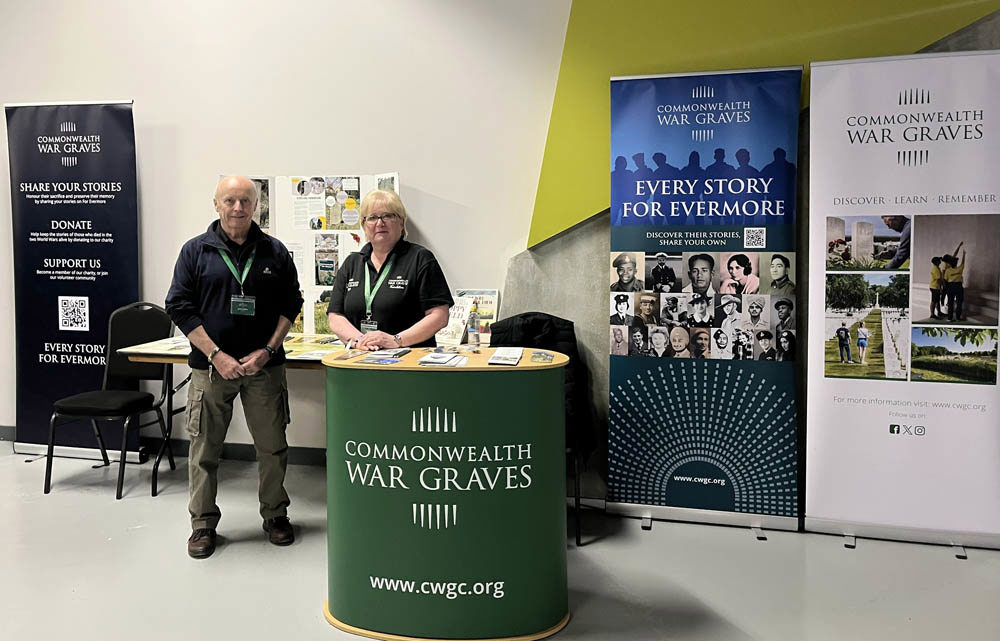
Image: Volunteers, including Colin, left, at the Tank Museum
A team of Commonwealth War Graves volunteers, co-ordinated by volunteer Colin MacNee, have established an ongoing Commonwealth War Graves presence at the Tank Museum, Dorset, during their major event days. Colin has volunteered for us for over 5 years and is also a volunteer at the Tank Museum. Using his contacts there, he has been able to establish a strong connection over the past three years.
The Tank Museum welcomes over 200,000 visitors a year, and by having a pop-up table being run by Colin at major events, such as Tank Fest, we have been able to expand our reach to those who may be interested in our work.
At the recent Tiger Day, where visitors from all over the world make the journey to see a genuine World War Two Tiger Tank in action, Colin and fellow volunteers Jeremy Orme and Tracey Oxendale spoke with over 50 members of the public and noted that the engagements were high quality, with some discussions lasting 30 minutes.
The photo was taken on the day and is an example of what can be achieved by the public engagement staff and volunteers with a simple set-up.
How to Volunteer with Commonwealth War Graves
We always want to hear from anyone interested in volunteering with us!
Head to the Volunteer page to discover the latest opportunities and ways you can get involved.
How to support the Commonwealth War Graves volunteer programmes
Here’s how your help and generosity supports our volunteer programmes:
- £10 could buy three hi-visibility vests to help keep our Eyes On Hands On volunteers safe
- £25 could provide for a welcome pack for one of our Eyes On Hands On volunteers to get them started in their role
- £40 could enable us to send one of our volunteer speakers to deliver an inspiring talk to a school or youth group
The best way to support our work is to become a CWGF Member.
For just £3 a month, not only do you get to support our volunteering, education, and outreach projects, but CWGF Members also enjoy:
- Access to CWGF Chats: a series of special online talks about the work of the Commission, as told by CWGC staff, as well as specialist subjects from renowned historians
- Priority access to our brilliant events
- A regular newsletter keeping you up to date with all the latest CWGF news
- A yearly impact report detailing our projects so you can really measure the effects your donations and support have on our work
- Your subscription to the Foundation Chronicle: our magazine detailing events, more Foundation insights, and interesting snippets of World War history
- A free CWGF calendar
Become a Member today and help us keep the memories of the Commonwealth’s war dead alive forever.
Don’t want to become a Member? Making a one-off donation is quick and easy. All of your donations go towards supporting CWGF projects. Please consider supporting us today.
Donate Online Now
By donating to the Commonwealth War Graves Foundation, you are helping us to keep the stories of the brave servicemen and women who died in the two World Wars alive. Can you help us ensure that their sacrifice is not forgotten?

Your donation enables us to continue sharing the inspiring stories of those like Ensign Violette Szabo, a brave SOE operative and spy who was executed in Ravensbrück concentration camp and posthumously awarded the George Cross. Violette is commemorated at our Brookwood Memorial.