
15 December 2025
We Tell Their Stories: Christmas Casualties of the World Wars
This festive period, why not take some time to remember those Commonwealth servicemen who died in the World Wars at Christmastime? We tell their stories here.
We Tell Their Stories
Christmas in the World Wars
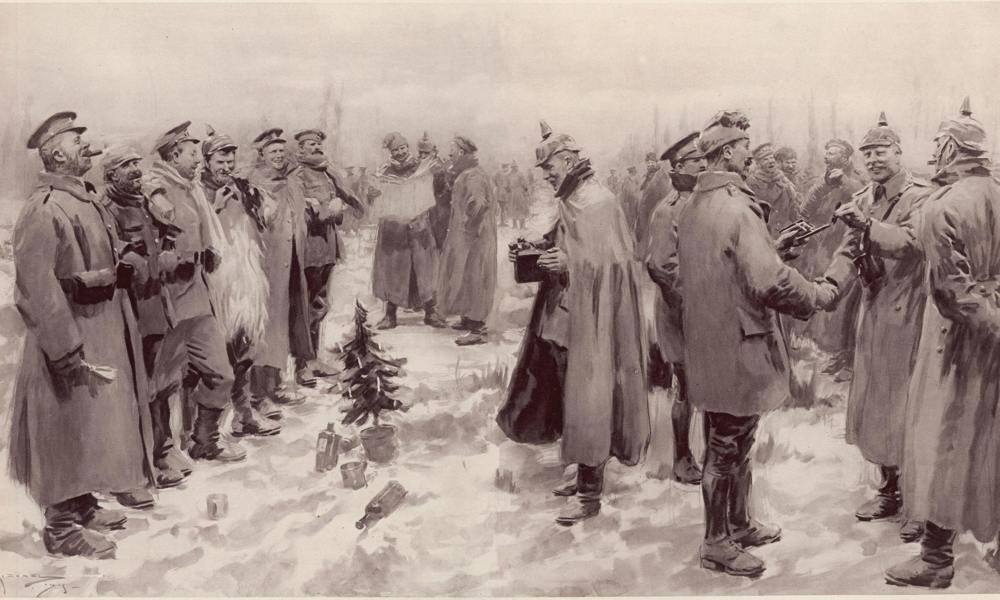
Image: The Christmas Truce as depicted in a December 1914 edition of the London Illustrated News (Wikimedia Commons)
Christmas and the First World War are closely linked. On Christmas Eve, small parts of the Western Front fell silent, save for the sounds of carolling and carousing in No Man’s Land. Here, British and German soldiers, bitter enemies just hours before, came together in the holiday spirit to stop fighting, share gifts, and generally embrace goodwill towards all men.
The Christmas Truce is one of the most remarkable events of the First World War, but sadly, it didn’t last. Even on Christmas Day 1914, British and Commonwealth units were fighting and dying while the Truce took place and no further truce occurred on Christmas during the Great War.
Christmas in the trenches, if the soldiers were not already engaged, was a chance to bring some extra comfort and human spirit to otherwise extraordinary situations. Soldiers shared gifts, opened presents sent from overseas, and even enjoyed treats like Christmas puddings in their dugouts. Wherever Commonwealth soldiers were serving, if they observed Christmas, they tried to make the most of it.
There was no miraculous Christmas Truce in the Second World War. Combat continued as and when necessary; otherwise, troops at home, in garrisons, or at the front did their best to enjoy the festive season if possible.
Sadly, not everyone made it back to enjoy Christmas in peacetime. Indeed, hundreds of Commonwealth servicemen fell in and around Christmastime. We share a handful of their stories below.
Christmastime casualties of the World Wars
Major Alexander Railton Campbell
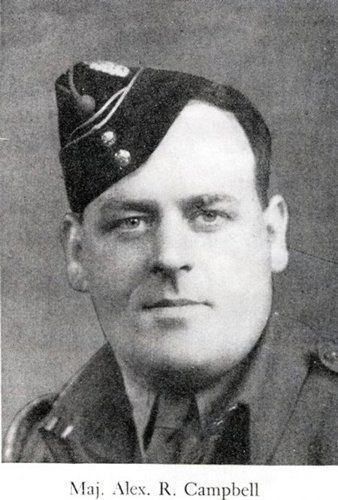 Image: Major Alex Campbell (Canadian Virtual War Memorial)
Alexander Campbell, Alex to his friends, was born in 1910 in Halifax, Nova Scotia, the third of five children to Captain Harry Davies Campbell.
The elder Campbell was a career soldier, serving for 16 years before heading overseas with the Canadian Expeditionary Force in the First World War and ultimately dying in France.
Like his father, Alex also felt the call to serve, serving in the Canadian Militia at age 18 in 1938. The following year, war broke out in Europe, and Canada declared war on Nazi Germany.
Alex was serving as a house painter at this time, choosing to enlist in 1940 with the Hastings & Prince Edward Regiment. He was soon shipped overseas.
Serving in the armed forces was personal for Alex. He blamed the Germans for his father’s death in 1917 and wanted to live up to his example. Alex’s militia background gave him a solid grounding as a soldier. His officers and trainers gave glowing reports of his abilities.
Nonetheless, Alex endured a frustrating period of inactivity upon his arrival in the UK in 1940 with his unit. It was not until late 1942 that Alex got his chance to taste combat.
He was one of a number of Canadian troops selected to gain vital combat experience alongside British units in the dust and deserts of North Africa. Alex was attached to the Coldstream Guards, and with them saw action in Tunisia during the closing stages of the Western Desert Campaign.
His time with the Coldstream Guards sharpened Alex’s soldiering skills, and, as he was considered an excellent infantry officer, he was soon rising through the ranks.
In the summer of 1943, the Allies launched their largest amphibious landing to date, Operation Husky, invading Sicily, Southern Italy. Alex was given a company command, leading men ashore as they stormed Sicily’s beaches, although he was shot in the arm.
Despite his wounds, Alex fought through July and August until he fell ill and was hospitalised in September. He spent several months in hospital, by which time the Allied invasion had reached mainland Italy itself.
Alex rejoined his company in Italy on December 24, just as the Canadians were attacking German positions over the swift-coursing Moro River. By now, Alex had been promoted to Major.
The Canadians were being held up by fierce machine-gun fire, stopping the river crossing. Alex’s section of 60 men was being pinned down near an Italian farmhouse.
Sensing an opportunity, Major Campbell gave the cry and charged headlong at the German positions. Despite his immense personal bravery, Alex was cut down. It was reported that the machine-gun fire in this section was so fierce that the Major’s body could not be recovered and buried for two days.
Today, Major Alex Railton Campbell is buried alongside more than 1,600 comrades at Moro River Canadian War Cemetery.
During a lull in the fighting in Italy, Alex crystallised his thoughts on leadership and his emotions taking men forward in the poem Prayer Before Battle. An extract is below:
“Make me more willing to obey,
Help me to merit my command,
And if this be my fatal day,
Reach out, Oh God, Thy Guiding Hand,
And lead me down that deep, dark vale.
These men of mine must never know
How much afraid I really am,
Help me to lead them in the fight
So they will say, ‘He was a man’”.
Captain Clive Franklyn Collett
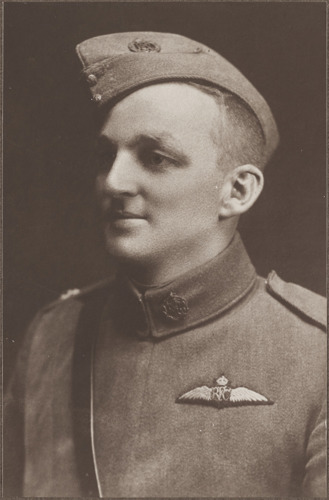 Image: Captain Clive Collett (Wikimedia Commons)
We all know the dangers and horrors the battlefields of the World Wars represented, but death in combat was by no means the only way service people lost their lives during these major conflicts.
Sickness, accidents, equipment malfunctions, injuries and other non-combat incidents all contributed to servicemen’s sad demises in wartime.
Captain Clive Franklyn Collett died in one such incident.
Clive hailed from Blenheim, New Zealand, but found himself in Britain at the start of the First World War in August 1914.
The Kiwi had already enlisted in the nascent Royal Flying Corps, graduating from flying school in January 1915. The newly minted pilot was commissioned as an officer in March and was transferred to No.11 Squadron RFC in May.
Clive spent some time bouncing between squadrons before settling with No. 18 Squadron in 1916. After finding squadron stability, Clive only spent a month flying over the Western Front before he was sent back to the UK, nursing a broken nose.
In June 1916, Clive’s career took another turn when he joined the RFC’s Experimental Station in Suffolk. It was his duty to test new aircraft and aviation innovations. For instance, he became the first person to parachute out of a British military aircraft, completing his jump in January 1917.
Clive was reassigned to a combat role in July 1917. Now at the controls of a Sopwith Camel and flying with No.70 Squadron, he earned his first aerial victory on 27 July 1917, taking out a German Albatros D.V biplane in the skies over Ypres, Belgium.
Clive continued to notch up victories, soon passing the five needed to be classed as a Fighter Ace, including one incident where he emerged victorious from three separate dogfights in one 45-minute period.
Shortly after, the prolific ace was injured in the hand and stood down from combat duties. He was awarded the Military Cross in September 1917, with a Bar being added in October.
Once healed, Clive was reassigned once more, this time to No.73 Squadron, but still took on test pilot duties. Sadly, his last flight was nigh.
On 23 December 1917, just two days before Christmas, Clive was performing testing duties on a captured Albatros, just like the one he shot down over France months before. He was last seen piloting the craft over the Firth of Forth, East Scotland, when his aeroplane suddenly dived, crashing into the grey, winter waves.
Clive was killed instantly, bringing an end to a great aviation career. He is buried in Comley Bank Cemetery, Edinburgh.
Lieutenant Leonard Castel Campbell Rogers
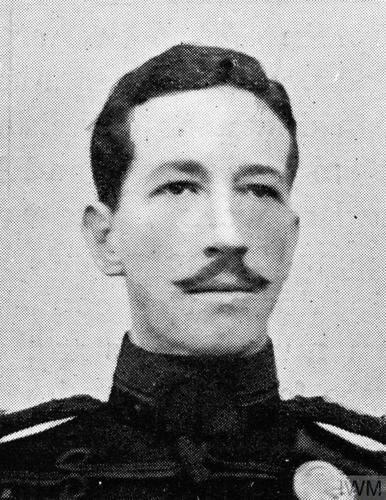 Image: Lieutenant Leonard Rogers (© IWM HU 125125)
Leonard Castel Campbell Rogers was born in Cuttack, Orissa, India on 29 January 1899, the son of Archibald Colin Campbell Rogers, an engineer with the Public Works Department, India.
It seems Leonard was always destined for a military career. After completing his education at Blundell’s School Tiverton, where he excelled at cricket and football, he enrolled in the Royal Military College Sandhurst. He was commissioned as an officer in the Bedfordshire Regiment in 1906.
A month after his promotion to Lieutenant in November 1908, he joined the Indian Army, gazetted to the 7th Gurkha Rifles. He was appointed the regimental Quartermaster in 1913.
Come the First World War, Lieutenant Rogers’s unit had been moved to the Western Front. As od December 1914, the 7th Gurkhas were in combat around Festubert, in Northern France.
It was here that Lieutenant Rogers lost his life. On 24 December 1914, the Loyal North Lancashire Regiment had put in a counterattack on German strong points near Festubert, and their dead and wounded still lay ahead of the positions now occupied by the 7th Gurkhas.
Noticing a wounded man North Lancs in No Man’s Land, Rogers went forward to rescue the stricken soldier. His charge proved too much for Lieutenant Rogers to carry alone, so another member of the 7th came out to help him.
Suddenly, the Gurkhas came under attack from a heavy burst of machine-gun fire. A German bullet whacked Rogers in the back, exiting through his ribs. The wounded soldier and his helper made it back to friendly lines. The heavily wounded Lieutenant Rogers staggered forward, fell into a ditch, and collapsed.
Leonard succumbed to his wounds and passed away on Christmas Morning, 1914.
For his gallantry, bravery, and self-sacrifice, Lieutenant Leonard Rogers was posthumously awarded the Military Cross, gazetted in February 1915.
Help us keep telling the stories of the Commonwealth’s war dead
Keeping the memories of our war dead alive and spreading our shared history is at the core of what we do at the Commonwealth War Graves Foundation.
Why not become a CWGF member? For just £36 a year, you can help us tell their stories while enjoying some big benefits:
- Access to CWG Chats: a series of special online talks about the work of the Commission, as told by CWGC staff, as well as specialist subjects from renowned historians
- Priority access to our brilliant events
- A regular newsletter keeping you up to date with all the latest CWGF news
- A yearly impact report detailing our projects so you can really measure the effects your donations and support have on our work
- Your subscription to the Foundation Chronicle: our magazine detailing events, more Foundation insights, and interesting snippets of World War history
- A free CWGF calendar
Thank you from everyone here at the Commonwealth War Graves Foundation.
Donate Online Now
By donating to the Commonwealth War Graves Foundation, you are helping us to keep the stories of the brave servicemen and women who died in the two World Wars alive. Can you help us ensure that their sacrifice is not forgotten?

Your donation enables us to continue sharing the inspiring stories of those like Ensign Violette Szabo, a brave SOE operative and spy who was executed in Ravensbrück concentration camp and posthumously awarded the George Cross. Violette is commemorated at our Brookwood Memorial.